gfxstream forwards guest Vulkan calls to a host GPU. On Linux, it relies on dma-buf, memfd, eventfd, epoll, SOCK_SEQPACKET, and native Vulkan drivers.
macOS already had several pieces in place. google/gfxstream included macOS host code from Android Emulator and earlier standalone build work (PR #109, PR #151). rutabaga_gfx compiled its FFI and gfxstream bindings on macOS, and Mesa had Metal WSI and KosmicKrisp.
I have worked across google/gfxstream, magma-gpu/rutabaga_gfx, and Mesa to get upstream libgfxstream_backend building and running on Apple Silicon over KosmicKrisp or MoltenVK, with macOS CI and unified-memory support. That lets VMs on macOS such as gbos-vm use rutabaga_gfx’s gfxstream backend. I have also ported kumquat (a virtio-gpu IPC server) and Mesa’s gfxstream Vulkan guest to macOS to test and debug the guest-to-host protocol without booting a VM.
How it works on macOS
VM guests and standalone macOS apps share the same libgfxstream_backend host renderer:
flowchart TB
    subgraph vm["VM Path (e.g. gbos-vm)"]
        direction TB
        AndApp["Android / Linux App<br/>Vulkan / ANGLE GLES"]
        AndGuest["Mesa gfxstream guest<br/>Vulkan ICD"]
        VirtIO["Linux virtio-gpu"]
        QEMU["QEMU (HVF)<br/>virtio-gpu-rutabaga"]
        RutFFI["rutabaga_gfx_ffi"]
        AndApp --> AndGuest --> VirtIO --> QEMU --> RutFFI
    end

    subgraph native["Standalone macOS Loop (kumquat)"]
        direction TB
        MacApp["macOS Vulkan App<br/>vkQuake / vkcube / dEQP"]
        MacGuest["Mesa gfxstream guest<br/>Metal WSI"]
        Magma["magma-gpu-rs<br/>Mach + kqueue + shm"]
        Kumquat["kumquat_virtio"]
        MacApp --> MacGuest --> Magma --> Kumquat
    end

    subgraph host["macOS Host Renderer"]
        direction LR
        Backend["libgfxstream_backend<br/>Vulkan decoder + memory types"]
        Loader["Vulkan Loader"]
        ICD["KosmicKrisp / MoltenVK"]
        Metal["Apple Metal"]
        Backend --> Loader --> ICD --> Metal
    end

    RutFFI --> host
    Kumquat --> host
- VM path: A Linux or Android guest talks to
virtio-gpu. QEMU’svirtio-gpu-rutabagadevice callsrutabaga_gfx_ffi, which sends commands straight tolibgfxstream_backendwithoutvirglrenderer. - Standalone macOS loop (
kumquat): macOS has no kernelvirtio-gpudriver, so Mesa’sgfxstreamguest defaults tokumquat. It talks to a localkumquat_virtioserver over Mach ports and POSIX shared memory, then presents through Metal WSI.
Upstream changes
google/gfxstream:libgfxstream_backendbuilds on Apple Silicon with Bazel, CMake, and Meson, and macOS CI checks all three. The Bazel workspace can also buildkumquat_virtioagainst it, and shared memory uses POSIXshm_openinstead ofmemfd. On unified-memory drivers such as KosmicKrisp,gfxstreamadds a guest-onlyDEVICE_LOCALmemory type so tiled images do not bind to imported host pointers.magma-gpu-rsandrutabaga_gfx: A Darwin backend replaces LinuxSOCK_SEQPACKET,eventfd, andepollwith Mach ports andkqueue. Because Metal cannot exportVkDeviceMemoryas adma-buffd, host-visible memory usesSystemBlob: the host importsshm_openmemory withVK_EXT_external_memory_hostand passes the fd to the guest.- Mesa: The macOS
gfxstreamVulkan guest (libvulkan_gfxstream.dylib) defaults tokumquatand sends commands over the AddressSpaceGraphics (ASG) ring buffer. For presentation through Metal WSI, the host copies each swapchain frame into shared memory and the guest blits it to aCAMetalDrawable.
sequenceDiagram
    participant App as macOS App
    participant Guest as Mesa Guest
    participant Server as kumquat_virtio
    participant HostVK as Host Vulkan

    Note over Guest,Server: 1. Mach port introduction
    Guest->>Server: connect /tmp/kumquat-gpu-0
    Server-->>Guest: bootstrap name (pid.count)
    Guest->>Server: bootstrap_look_up + port swap
    Note over Guest,Server: Intro port dropped<br/>IPC uses mach_msg + kqueue

    Note over Guest,HostVK: 2. Host-visible memory (SystemBlob)
    App->>Guest: vkAllocateMemory / vkMapMemory
    Guest->>Server: vkAllocateMemory
    Server->>Server: shm_open + ftruncate + mmap
    Server->>HostVK: VK_EXT_external_memory_host
    Guest->>Server: RESOURCE_CREATE_BLOB
    Server-->>Guest: mach_msg + fileport (shm fd)
    Guest->>Guest: mmap(shm fd)

    Note over App,HostVK: 3. Submit and present
    App->>Guest: vkQueueSubmit + vkQueuePresentKHR
    Guest->>Server: ASG ring cmds + ping
    Server->>HostVK: decode, render, copy to shm
    Guest->>Server: vkWaitForFences (ASG ring)
    Server-->>Guest: fence signaled
    Guest->>Guest: blit MTLBuffer to CAMetalDrawable
Examples
Googlebook VM (gbos-vm)
Rarasinhoo/gbos-vm runs unmodified Android 17 Googlebook OS system partitions on Apple Silicon at up to 120 Hz. The guest uses Cuttlefish kernel modules, vendor HALs, and a standalone build of AOSP Mesa’s Android gfxstream Vulkan driver (vulkan.ranchu.so, with a small patch).
The host runs UTM’s QEMU 10.0.12 (HVF, built as a shared library) with upstream rutabaga_gfx_ffi and libgfxstream_backend over MoltenVK, enabling VulkanAllocateHostMemory and VulkanVirtualQueue, plus gbos-vm’s own zero-copy Metal scanout patch.
The full gbos-vm pipeline looks like this:
flowchart TB
    subgraph guest["Android 17 Guest VM (Googlebook OS + Cuttlefish HALs)"]
        direction TB
        subgraph apps["Android Framework & Apps"]
            direction LR
            Apps["Apps / Chrome / HWUI"]
            ANGLE["ANGLE<br/>GLES → Vulkan"]
            SF["SurfaceFlinger<br/>skiavk"]
            Apps --> ANGLE
        end
        subgraph hals["Cuttlefish & Mesa Vendor Layer"]
            direction LR
            VkGuest["Mesa gfxstream<br/>Vulkan guest"]
            Minigbm["Cuttlefish<br/>minigbm"]
            HWC3["Cuttlefish<br/>DRM HWC3"]
        end
        KMod["Initrd Kernel Modules<br/>virtio-gpu + dma-buf (Cuttlefish)<br/>virtio-pci (Googlebook signed)"]
        ANGLE --> VkGuest
        Apps --> VkGuest
        SF --> VkGuest
        SF --> Minigbm
        SF --> HWC3
        VkGuest --> KMod
        Minigbm --> KMod
        HWC3 --> KMod
    end

    subgraph qemu["QEMU 10.0.12 (HVF)"]
        direction TB
        VGPU["virtio-gpu-rutabaga<br/>hostmem=8G"]
        Rutabaga["rutabaga_gfx_ffi"]
        GfxHost["libgfxstream_backend<br/>HostMem + VirtualQueue"]
        MVK["MoltenVK → Apple Metal"]
        SpiceMetal["SPICE Metal Display<br/>RGBA → BGRA IOSurface"]

        VGPU -->|"scanout + MTLTexture"| SpiceMetal
        VGPU -.->|"get<br/>MTLTexture"| GfxHost
        VGPU --> Rutabaga --> GfxHost --> MVK
    end

    subgraph viewer["Googlebook VM.app (CocoaSpice)"]
        direction LR
        CSDisplay["CSDisplay<br/>IOSurface → shadow"]
        CSRenderer["CSMetalRenderer<br/>MTKView (guest clock)"]
        CSDisplay --> CSRenderer
    end

    KMod ==>|"VirtIO PCI + HVF"| qemu
    SpiceMetal ==>|"IOSurface + SPICE"| viewer
vkQuake
On macOS, vkQuake used to link MoltenVK directly, so VK_DRIVER_FILES could not select another driver. Novum/vkQuake#1041 added a -Duse_vulkan_loader=enabled Meson option to link the Vulkan loader instead.
Running the shareware pak0.pak through kumquat_virtio in a 1280×720 window (2560×1440 backing pixels at 2×), vkQuake reports Virtio-GPU GFXStream (Apple M2 Pro). On a 120 Hz MacBook Pro display, timedemo demo1 (969 frames) runs at about 118 fps on KosmicKrisp and 117–118 fps on MoltenVK. Native runs hit the same 118–120 fps limit because presentation is capped by the display refresh rate.
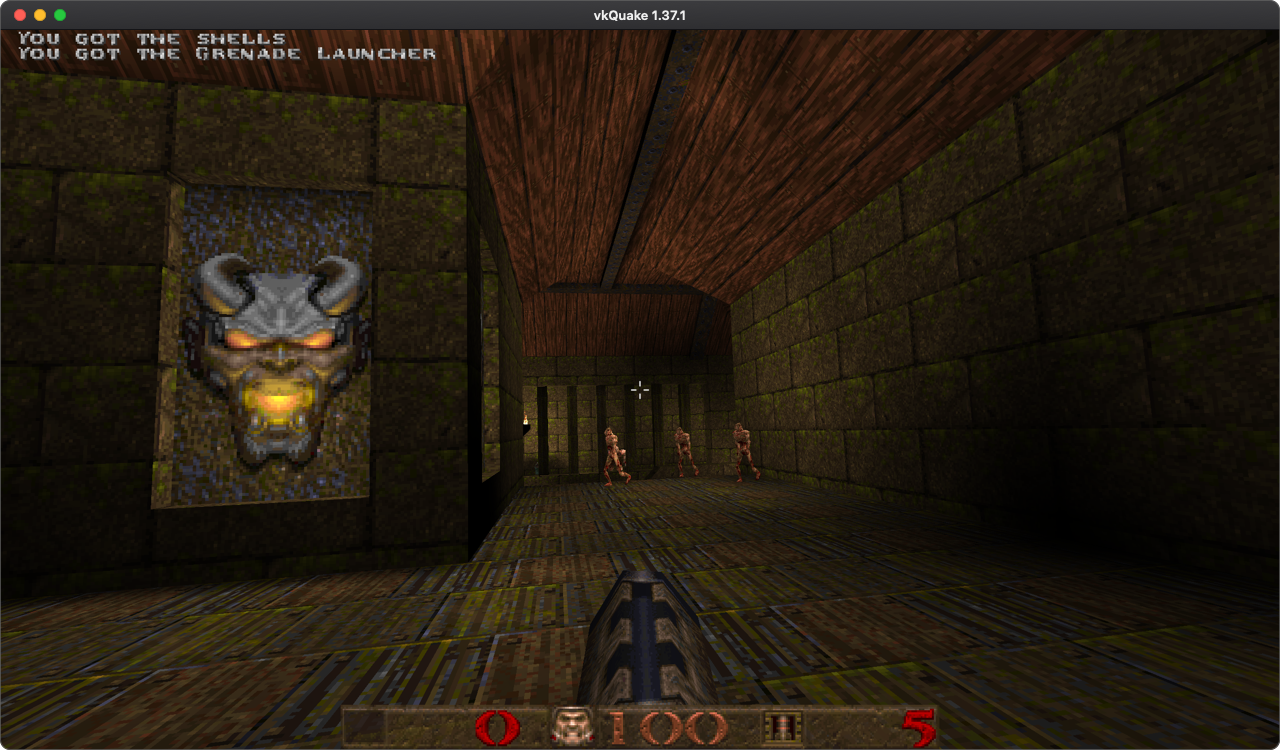
vkcube, dEQP-VK, and Sascha Willems Vulkan samples
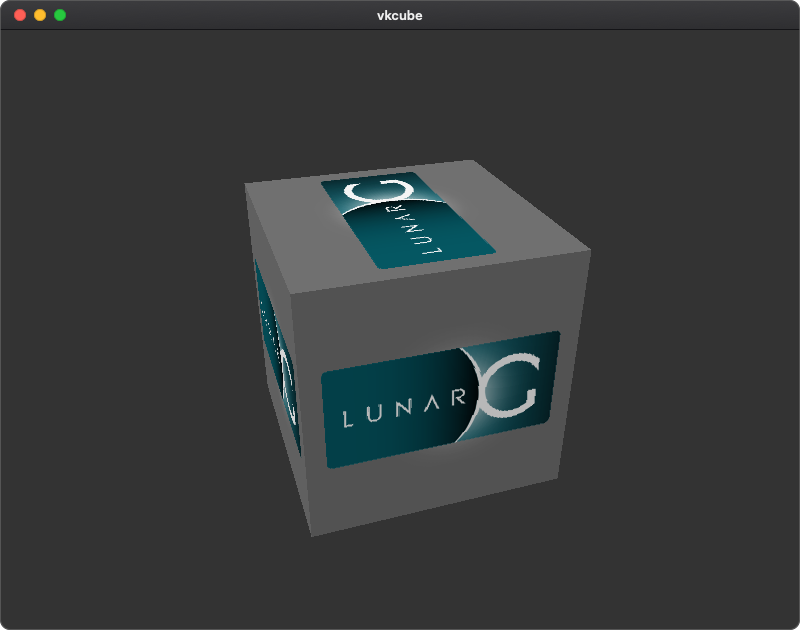
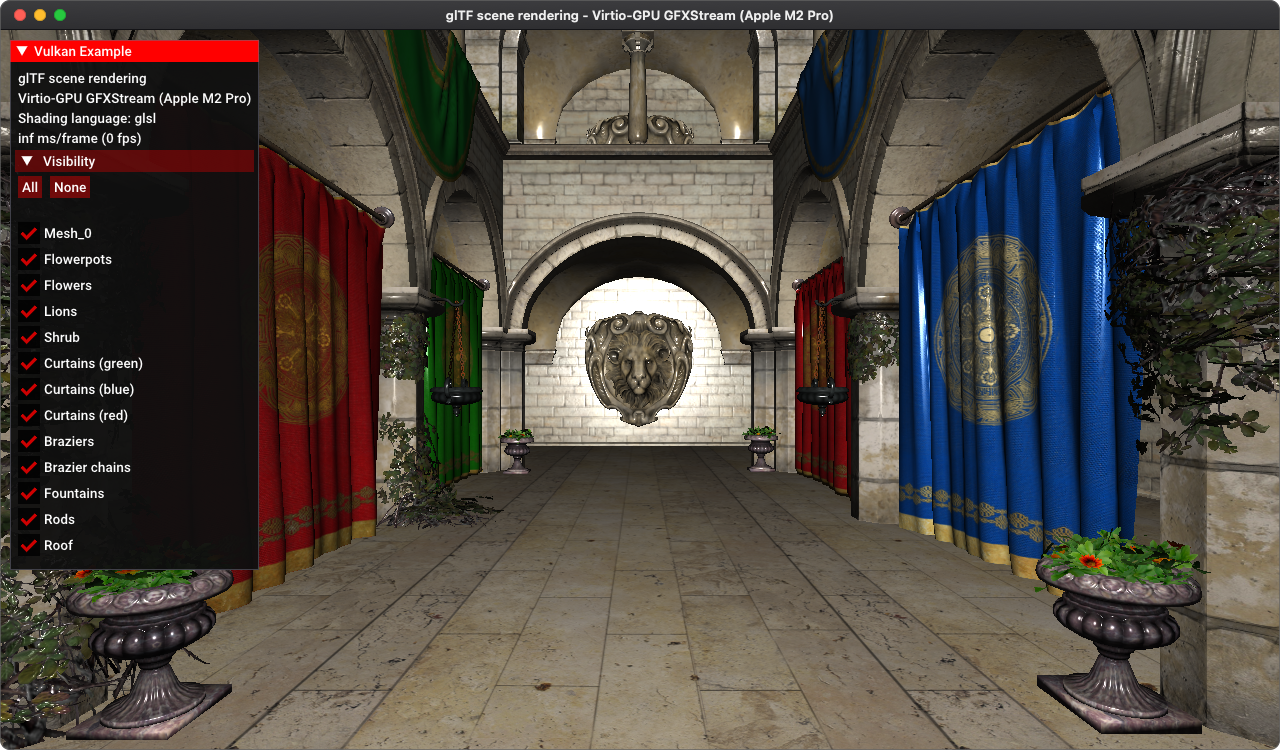
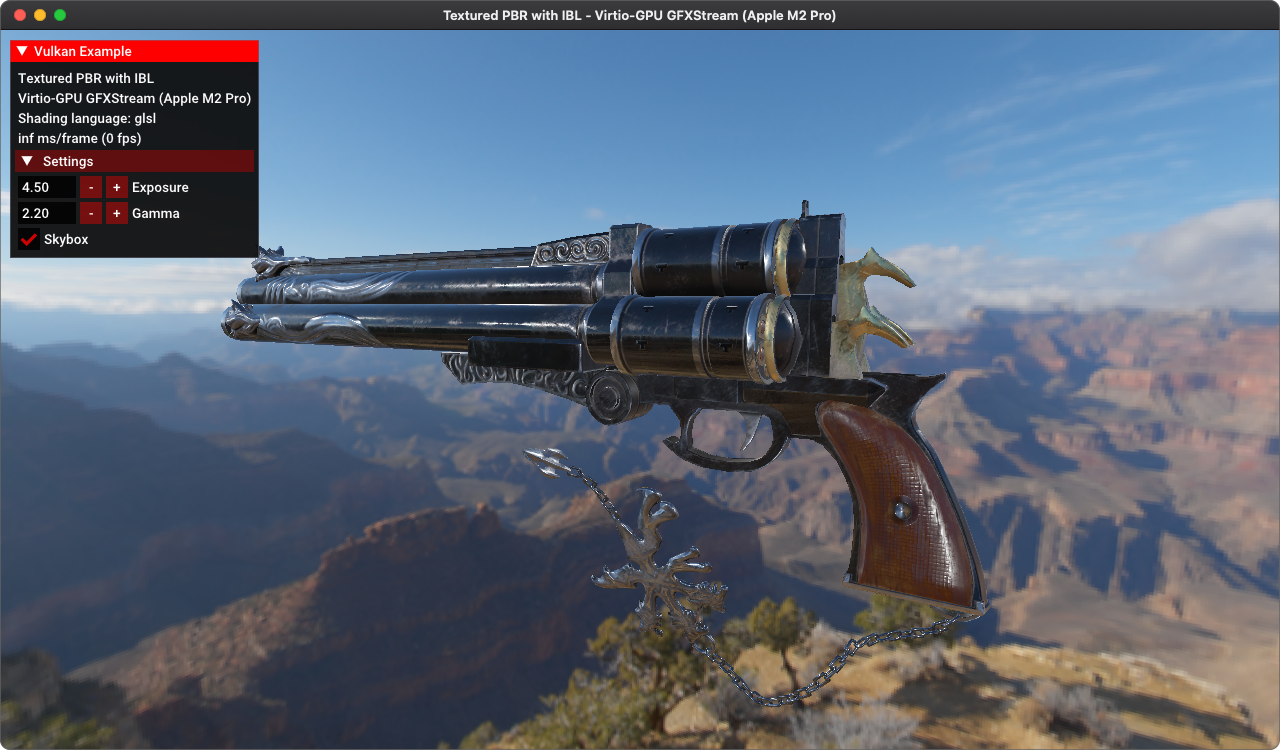
vkcube works on both host drivers. The dEQP-VK smoke and Metal WSI subset (dEQP-VK.api.smoke.*, dEQP-VK.wsi.metal.surface.*, and basic swapchain create, acquire, and render cases) has zero failures: 32 of 45 pass on KosmicKrisp and 33 of 45 on MoltenVK, while the rest report not supported. Before the extension update below, I also ran 99 of Sascha Willems’ Vulkan samples (300 frames each) natively and through gfxstream:
| Mode | Passing (of 99) |
|---|---|
| Native KosmicKrisp | 74 |
gfxstream → KosmicKrisp |
64 |
| Native MoltenVK | 73 |
gfxstream → MoltenVK |
64 |
The 25–26 native failures come from features Metal lacks, such as ray tracing and mesh shaders. Most of the extra gfxstream failures came from extension filtering, since the host only advertises extensions its generated decoder knows. Mesa !44894 exposed six KHR extensions that both KosmicKrisp and MoltenVK already support: VK_KHR_timeline_semaphore, VK_KHR_push_descriptor, VK_KHR_depth_stencil_resolve, VK_KHR_dynamic_rendering_local_read, VK_KHR_device_group_creation, and VK_KHR_device_group. With the matching host decoder update (now in google/gfxstream), KosmicKrisp passes rose from 64 to 70 of 99.
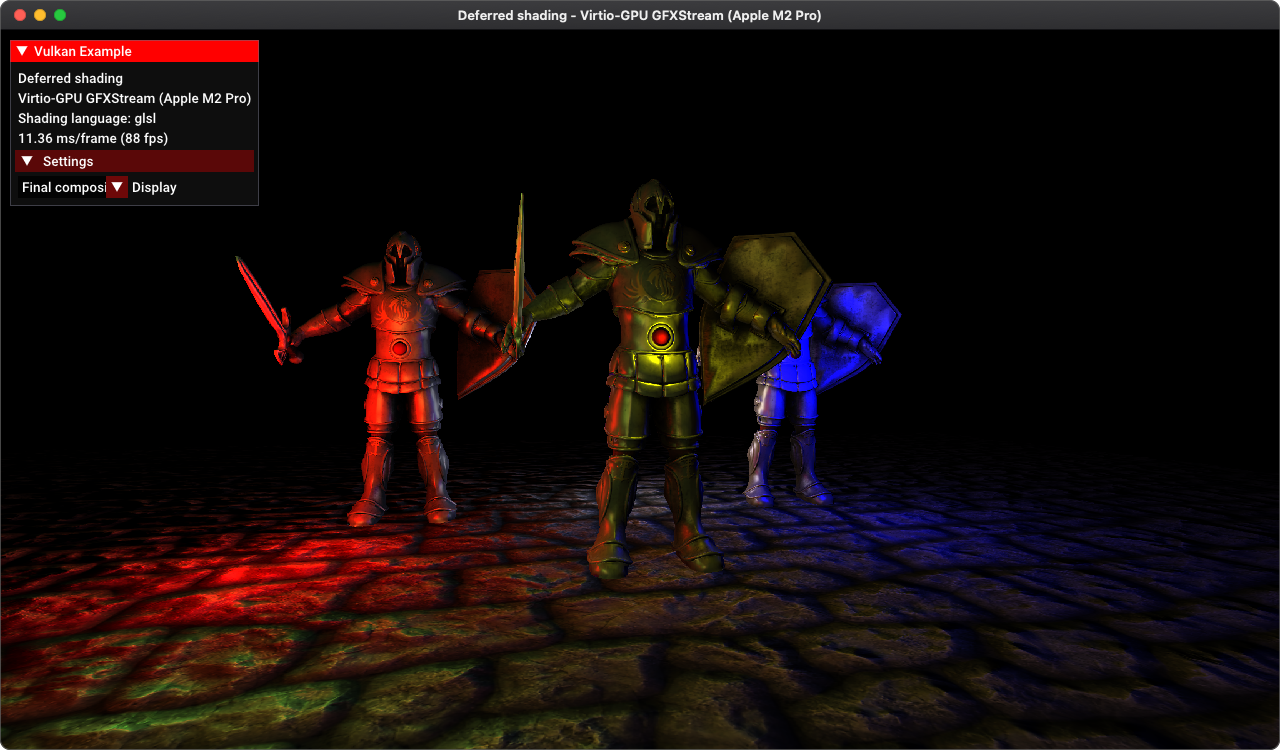
Captured on an Apple M2 Pro through kumquat_virtio and KosmicKrisp:
Running it locally
Build kumquat_virtio from google/gfxstream and the guest and host drivers from Mesa. KosmicKrisp needs Homebrew llvm, spirv-llvm-translator, and spirv-tools, with keg-only llvm on PATH; drop kosmickrisp from -Dvulkan-drivers if you use MoltenVK on the host:
# In google/gfxstream
bazel build @rutabaga//:rutabaga_gfx_kumquat_server

# In mesa
PATH="$(brew --prefix llvm)/bin:$PATH" \
meson setup build \
  -Dvulkan-drivers=gfxstream,kosmickrisp \
  -Dgallium-drivers= \
  -Dopengl=false \
  -Dvirtgpu_kumquat=true \
  -Dplatforms=macos
ninja -C build
Then start the server and a client:
# Terminal 1: host kumquat server on KosmicKrisp (or MoltenVK)
DYLD_FALLBACK_LIBRARY_PATH=/opt/homebrew/lib \
VK_DRIVER_FILES=/path/to/mesa/build/src/kosmickrisp/vulkan/kosmickrisp_mesa_devenv_icd.aarch64.json \
  bazel-bin/external/+git_repository+rutabaga/kumquat_virtio

# Terminal 2: client via the gfxstream guest ICD
# (Mesa >= c01f84441bc enables kumquat by default on macOS; older builds need VIRTGPU_KUMQUAT=1)
VK_DRIVER_FILES=/path/to/mesa/build/src/gfxstream/guest/vulkan/gfxstream_vk_devenv_icd.aarch64.json \
  vulkaninfo --summary
Use DYLD_FALLBACK_LIBRARY_PATH=/opt/homebrew/lib instead of DYLD_LIBRARY_PATH. DYLD_LIBRARY_PATH overrides even absolute library_path entries inside ICD manifests, while DYLD_FALLBACK_LIBRARY_PATH only applies to bare names like libvulkan.dylib. When selecting MoltenVK with VK_DRIVER_FILES, also set MVK_CONFIG_USE_METAL_ARGUMENT_BUFFERS=0. Otherwise gfxstream only sets it internally under ANDROID_EMU_VK_ICD=moltenvk.
Related work: Meta’s Cuttlefish on Mac
On November 13, 2026, Meta Reality Labs published Cuttlefish on Mac. It ports Cuttlefish’s QEMU backend for Android 16 to Apple Silicon using a qemu-wearables fork and a cuttlefish-wearables AOSP patch bundle.
Most of their changes are in the VMM and Cuttlefish host tools. They enabled QEMU’s vhost-user frontends, libvhost-user, and contrib/vhost-user-blk on macOS. For Cuttlefish daemons such as vhost-device-vsock, they added a Rust epoll-over-kqueue shim and C++ kqueue replacements. In QEMU 9.2, they raised HVF memory-region slots from 32 to 512 (92be519d5f97), updated the Cocoa display (BGRA, click-as-touch, -g geometry, window resize), and added JIT code signing.
For graphics, Meta built on AOSP Android 16’s external/crosvm and hardware/google/gfxstream, where gfxstream already had Apple CMake support. crosvm/0001 fixed a Cargo build error in rutabaga_gfx_ffi, gfxstream/0001 ported gfxstream_graphics_detector by probing /opt/homebrew/lib/libMoltenVK.dylib, and mesa3d/0001 got Lavapipe compiling on macOS. In qemu-wearables, 605dafded0dc defined RUTABAGA_GFX_FFI_UNSTABLE in virtio-gpu-rutabaga.c to match the Rust FFI’s GPU fence fields. cuttlefish/0028 removed macOS guards so Cuttlefish uses AOSP’s virtio-gpu-rutabaga config (hostmem=256M, x-gfxstream-composer=on) and points VK_DRIVER_FILES at MoltenVK_icd.json or lvp_icd.aarch64.json.
cuttlefish-wearables documents how to build the Soong host package (cvd-host_package.tar.gz) and points to qemu-wearables, a publish-only mirror without a standalone macOS build script for QEMU and rutabaga_gfx_ffi.
Here is how Meta’s stack fits together:
flowchart TB
    subgraph guest["Android 16 Guest VM (Cuttlefish gfxstream_guest_angle)"]
        direction TB
        subgraph apps["Android Framework & Apps"]
            direction LR
            Apps["Apps / HWUI"]
            ANGLE["ANGLE<br/>GLES → Vulkan"]
            SF["SurfaceFlinger<br/>RenderEngine"]
            Apps --> ANGLE
            SF --> ANGLE
        end
        subgraph hals["Cuttlefish & Mesa Vendor Layer"]
            direction LR
            VkGuest["Mesa gfxstream<br/>Vulkan guest"]
            Minigbm["Cuttlefish<br/>minigbm"]
            HWC3["Cuttlefish<br/>Ranchu HWC3"]
        end
        KMod["Linux Guest Kernel<br/>virtio-gpu + dma-buf"]
        ANGLE --> VkGuest
        Apps --> VkGuest
        SF --> VkGuest
        SF --> Minigbm
        SF --> HWC3
        VkGuest --> KMod
        Minigbm --> KMod
        HWC3 --> KMod
    end

    subgraph qemu["QEMU 9.2 (HVF, 512 slots, JIT-signed)"]
        direction TB
        VGPU["virtio-gpu-rutabaga<br/>gfxstream-vulkan=on<br/>x-gfxstream-composer=on"]
        Rut["rutabaga_gfx_ffi<br/>AOSP external/crosvm<br/>(UNSTABLE ABI)"]
        Gfx["libgfxstream_backend<br/>AOSP + MoltenVK / Lavapipe"]
        Cocoa["Native Cocoa Display<br/>BGRA, click-as-touch, -g"]

        VGPU --> Rut --> Gfx
        VGPU -->|"scanout"| Cocoa
    end

    subgraph cf["Cuttlefish Host (cuttlefish-wearables)"]
        direction LR
        Orch["Cuttlefish Orchestration<br/>gfxstream_graphics_detector"]
        Vhost["vhost-user (kqueue)<br/>vsock, input"]
        Orch --> Vhost
    end

    KMod ==>|"VirtIO PCI + HVF"| qemu
    Orch -.->|"launch"| qemu
    Vhost -.->|"vhost-user"| qemu
Stack comparison
All three setups place libgfxstream_backend behind rutabaga_gfx to decode guest Vulkan calls for KosmicKrisp or MoltenVK on Metal, or Lavapipe on CPU. I have been working on the upstream graphics and transport repos (google/gfxstream, magma-gpu/rutabaga_gfx, and Mesa) so both VMs and VM-free tests can run on macOS. Meta builds on AOSP’s external/crosvm and hardware/google/gfxstream instead, focusing on Cuttlefish orchestration and QEMU 9.2.
flowchart TB
    subgraph up["Upstream Graphics Stack"]
        direction TB
        UpApp["Client: macOS App<br/>Mesa Metal WSI + kumquat"]
        UpVM["VM + VMM: gbos-vm<br/>QEMU 10 + virtio-gpu-rutabaga"]
        UpRut["Transport: rutabaga_gfx<br/>kumquat_virtio / rutabaga_gfx_ffi<br/>(upstream magma-gpu/rutabaga_gfx)"]
        UpGfx["Renderer: libgfxstream_backend<br/>Vulkan decoder + unified memory<br/>(upstream google/gfxstream)"]
        UpICD["Host Driver<br/>KosmicKrisp or MoltenVK → Metal"]

        UpApp --> UpRut
        UpVM --> UpRut
        UpRut --> UpGfx --> UpICD
    end

    subgraph meta["Meta: Cuttlefish + QEMU Stack"]
        direction TB
        MetaCF["Orchestration: Cuttlefish<br/>vhost-user (kqueue) + detector<br/>(cuttlefish-wearables)"]
        MetaQEMU["VMM + Display: QEMU 9.2<br/>virtio-gpu-rutabaga + Cocoa<br/>(qemu-wearables)"]
        MetaRut["Transport: rutabaga_gfx_ffi<br/>RUTABAGA_GFX_FFI_UNSTABLE<br/>(AOSP external/crosvm)"]
        MetaGfx["Renderer: libgfxstream_backend<br/>Vulkan decoder<br/>(AOSP hardware/google/gfxstream)"]
        MetaICD["Host Driver<br/>MoltenVK or Lavapipe → Metal/CPU"]

        MetaCF --> MetaQEMU --> MetaRut --> MetaGfx --> MetaICD
    end
| Stack | VMM / Transport | rutabaga_gfx source |
Host gfxstream and Vulkan ICD |
Display path |
|---|---|---|---|---|
Standalone macOS loop (kumquat) |
No VM (kumquat over Mach ports + shm_open) |
Standalone magma-gpu/rutabaga_gfx (kumquat_virtio → gfxstream) |
Upstream google/gfxstream + KosmicKrisp or MoltenVK |
Guest Mesa Metal WSI (CAMetalDrawable) |
gbos-vm (Android 17) |
UTM QEMU 10.0.12 (HVF), virtio-gpu-rutabaga (hostmem=8G, no virglrenderer) |
Standalone magma-gpu/rutabaga_gfx (rutabaga_gfx_ffi, --features gfxstream) |
google/gfxstream (+ scanout patch) + MoltenVK |
Zero-copy MTLTexture → SPICE Metal display → IOSurface → CocoaSpice MTKView |
| Meta Cuttlefish on Mac | QEMU 9.2 (HVF, 512 slots), virtio-gpu-rutabaga (hostmem=256M, x-gfxstream-composer=on) |
AOSP external/crosvm (rutabaga_gfx_ffi, RUTABAGA_GFX_FFI_UNSTABLE) |
AOSP hardware/google/gfxstream + MoltenVK or Lavapipe |
QEMU native Cocoa display (BGRA) |